Customer Story
How Rakuten France turned every team into AI builders with Custom Agents

When Rakuten France set out to help teams automate repetitive work, they knew a four-person AI team alone couldn't get them there—so they built a simple system for employees to create their own Custom Agents in minutes. Today, more than 80 agents run across the company, and automation no longer depends on a central team.
Automation that anyone can build
For e-commerce marketplace Rakuten France, the math was simple: a four-person AI team can't be everywhere at once. "Our role isn't just to build automation solutions for the company—it's to act as a catalyst and spread best practices to every team," explains CPO Clément Caillol.
They tried no-code tools before, but the results didn't last. Someone would build a workflow, move to another role, and the automation would inevitably break. Rakuten France needed a more durable solution, which they found in a core company value: shikumika. Roughly translating to "systematization," it means designing a workflow so a specific result can be achieved consistently, regardless of who performs the task—and became AI Lead Sidney Golstein's north star.
When Sidney started using Custom Agents, his first move wasn't to start automating his own tasks. Instead, he asked a harder question: How do you build something the entire company can use without the AI team becoming the bottleneck?
If a non-technical team thinks Custom Agents aren't for them, it's actually the opposite—they're built for non-technical people.

The foundation for company-wide AI
As Sidney explored what’s possible with Custom Agents, he started thinking about scale. Custom Agents are easy to build, but without shared standards, every employee would write instructions differently and reinvent the same solutions from scratch. "I started by creating an agent. I saw how it worked. Then I tried to get agents to communicate with each other,” explains Sidney. “That's where the idea came from to build a whole internal platform of agents within Notion.”
He started by creating Shared Operating Procedures that every agent references, so new agents start with the same standards. Instead of telling every new agent what it needs to know, such as how to log a run, scrape data, or optimize instructions, Sidney captured this common knowledge once in Notion.
With the guardrails in place, the next thing Sidney built is the Rakuten Agent Builder: a Custom Agent designed specifically to create other Custom Agents. When someone at Rakuten France wants to automate a workflow, they open a conversation with the Agent Builder and describe what they need in plain language. The Builder asks a few clarifying questions, drafts the full instructions, automatically incorporates the SOPs, and generates a step-by-step setup guide.
Instead of everyone writing instructions from scratch, the entire company creates agents the exact same way: through a simple chat. “In 10–20 minutes, a new agent can be live,” Sidney shares. “The simplicity of creation is the key point.”
To roll it out, Sidney hosted workshops where every team built their first agent live in the room. And to ensure a smooth start, new users are greeted by the Friendly Onboarder, a Custom Agent that walks them through exactly what to expect before they start building.
One person laid the foundation. Now anyone at Rakuten France can build on it.
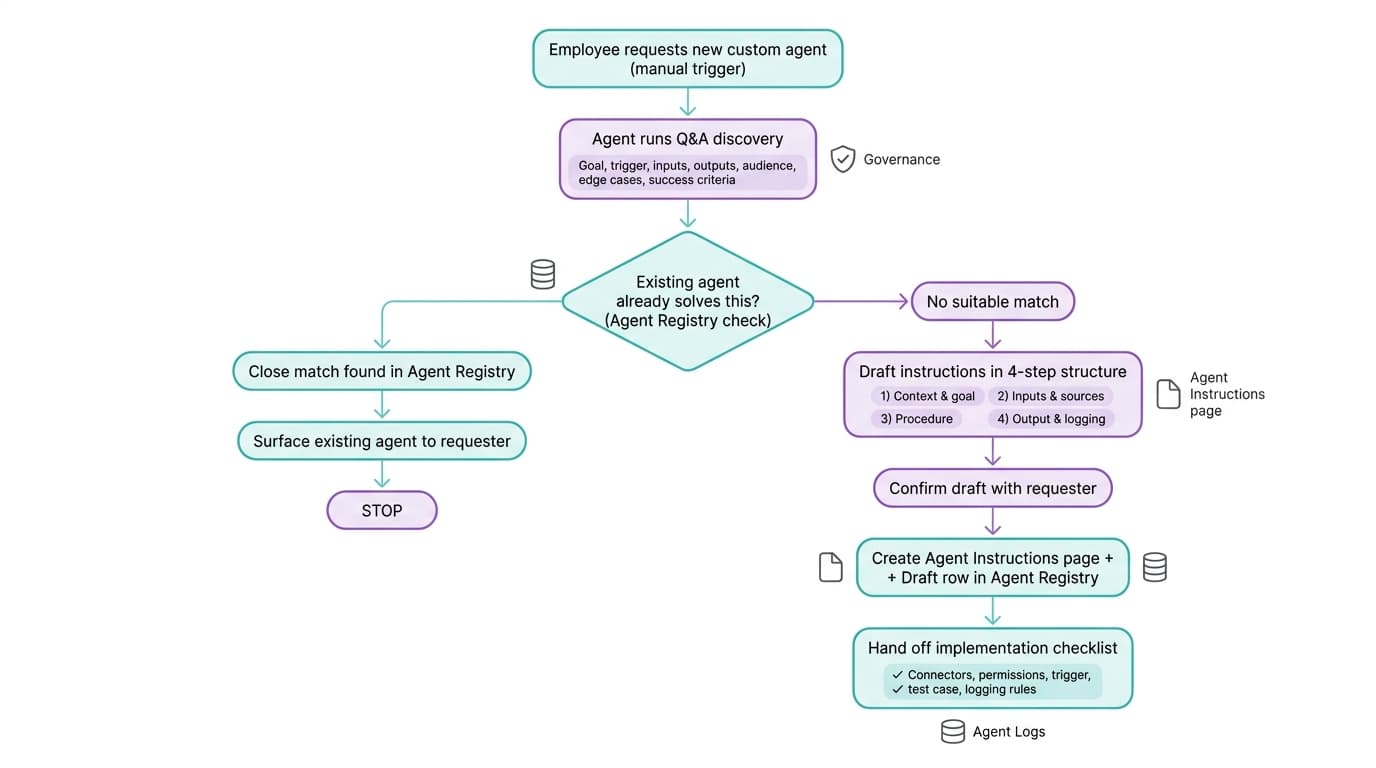
Anyone at Rakuten France can create Custom Agents—which means anyone can increase their productivity, almost infinitely.
The infrastructure behind the agents
Because Rakuten France already works in Notion, their Custom Agents don’t operate in a vacuum. Behind them is a set of interconnected components that work together to keep every agent aligned, discoverable, and improving over time. As a result, Sidney’s team maintains complete visibility and control over how AI is used across the company.
Safety and transparency are built into the foundation. Every new Custom Agent is automatically added to a central Agent Registry database so employees can discover existing workflows instead of duplicating effort.
After every run, agents write a structured entry to a shared Agent Logs database. These logs capture exactly what triggered the run, what actions the agent took, and whether anything failed.
A separate Custom Agent, the Delicious Improver, reviews the logs to spot patterns, surface fixes, and propose updates to the SOPs. Every suggestion goes to the agent's owner for review. Nothing changes without approval, ensuring humans remain in the loop.
“We have a system where one Custom Agent creates agents; the agents that were created run and log; and another Custom Agent reviews the logs and improves the agent that just ran,” explains Sidney. “That makes the system self-learning—a closed loop.”
This is shikumika made operational. Sidney built the framework once. Now the framework builds itself.
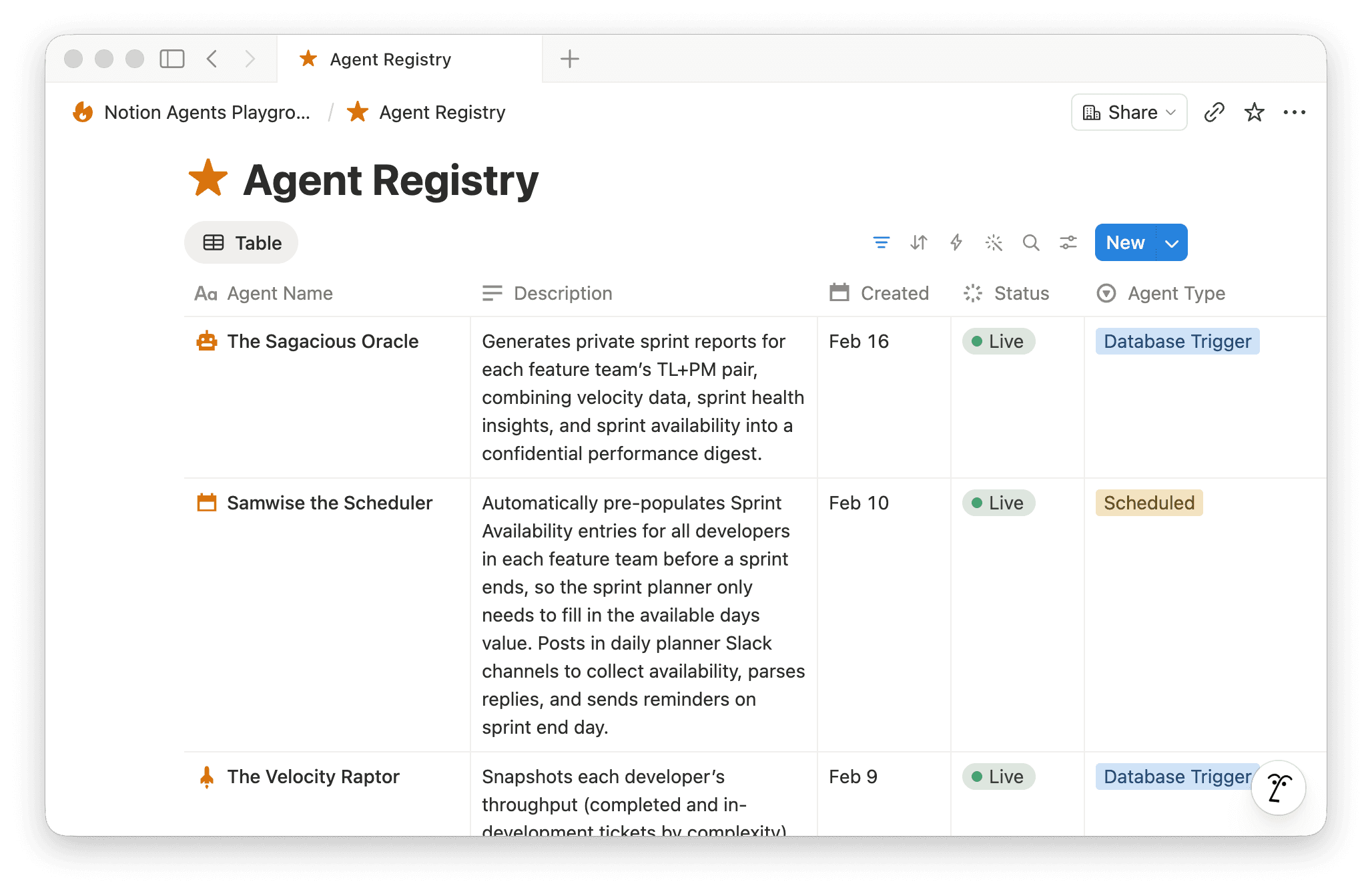
Status updates that write themselves
The product team offered the perfect testing ground. While Rakuten France manages its development backlog in Notion, tracking the health of every ticket—spotting items stuck in review or overdue releases—was manual and reactive.
To automate this process, Sidney built three Custom Agents: Plan Snitch, Run Snitch, and Release Snitch. Every night, they scan active tickets against a defined set of best practices and log their findings in a dedicated Notion database. A ticket in review for more than three days or a release marked overdue? The agent flags it.
Every morning, the Sprint Lebowski agent reads those findings and posts a tailored report to each team's Slack channel—before tech leads, product managers, and release managers have even logged on. Backlog health issues have dropped measurably, with some teams cutting them by 50 percent. Other teams, such as user care, have asked to have Sprint Lebowski set up after seeing the results.
What converted skeptics across the company wasn't a pitch—it was the daily Slack report, delivered exactly where people already worked, in a format they could act on immediately. “I didn't have to sell Custom Agents,” admits Sidney. “Others saw what the product team was getting every morning and asked if they could have it too.”
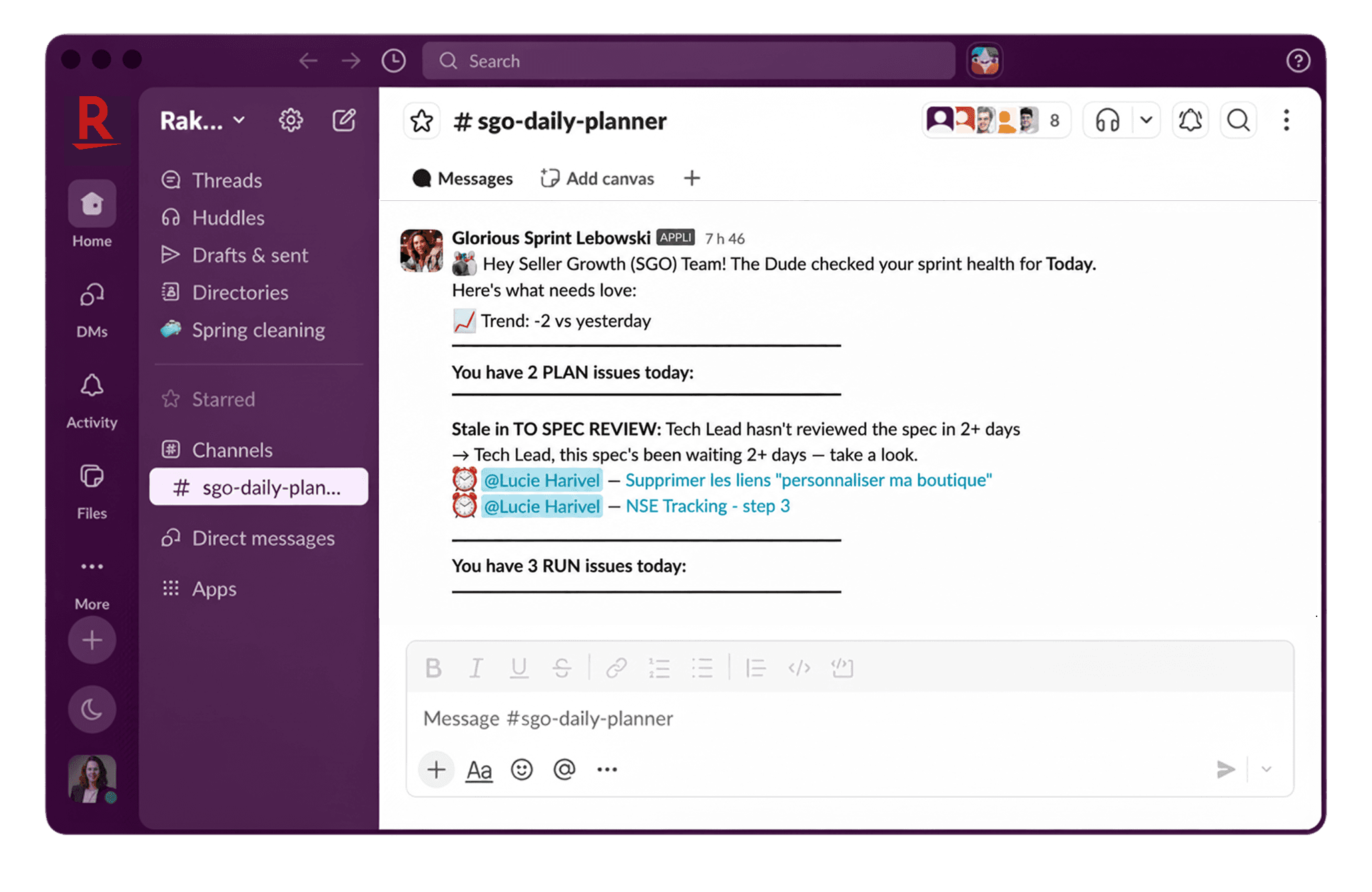
Custom Agents are a pragmatic productivity win: less manual coordination, more reliable execution, and better knowledge-sharing across teams.

When everyone becomes a builder
Today, Rakuten France relies on Custom Agents daily, with 80+ agents running across the company. Most weren't built by Sidney's team, with adoption spreading organically. When teams see colleagues automating their busywork, they immediately want to do the same.
Clément describes this shift in a single word: reflexivity. "It's as if, equipped with a new capability, people start asking: Is what I'm doing automatable? How does it work? What part does it represent within the larger system?” That reflexivity pushes everyone to think systemically. Instead of solving a problem once and moving on, teams are building workflows that can be reused and shared.
The AI team's job has also fundamentally changed. They're no longer the builders—they're the platform. “My job used to be building agents. Now it's making it easy for everyone else to build them,” Sidney reflects.
Custom Agents helped us move beyond individual AI experiments and into a real, scalable way of working.